

After overview of Oracle Universal Content Management (UCM from Stellent) here, today’s post covers Installation of Oracle Content Server (Repository for UCM – Web Content Management, Document Management, Record Management ….). Content Server is key component of UCM which contains repository of UCM (solution from Stellent).
.
Assumptions with Content Server (repository for UCM) Installation
1. Database : We are using Oracle 10.2.0.1 as database for Content Server, other supported databases are MS-SQL, IBM DB2, Sybase…
2. Web Server : We are using Oracle HTTP Server (powered by Apache) as Web Server, other supported web servers are Sun One Server, IBM HTTP Server, stand alone Apache…
3. JDK : Content Server comes with its own JDK but installation gives you option to use existing JDK (Java Development Kit) on server.
.
Database Preparation
1. Install Oracle 10.2.0.1 database on Linux , check here or here
2. Create tablespace for content server data
SQL> create tablespace content_system datafile ‘/datafile_location/content_system01.dbf’ size 300M;
3. Create temporary tablespace for content server data
SQL> create temporary tablespace content_temp tempfile ‘/datafile_location/content_temp.dbf’ size 100M;
4. Create database user like db_admin
SQL> create user db_admin identified by db_admin temporary tablespace content_temp default tablespace content_system;
5. Create role like
SQL> CREATE ROLE stellent_role;
SQL> GRANT CREATE SESSION TO stellent_role;
SQL> GRANT CREATE TABLE TO stellent_role;
SQL> GRANT CREATE TYPE TO stellent_role;
SQL> GRANT CREATE PROCEDURE TO stellent_role;
SQL> GRANT CTXAPP TO stellent_role;
6.Grant role and unlimited tablespace to content db user
SQL> GRANT stellent_role to db_admin;
SQL> GRANT UNLIMITED TABLESPACE TO db_admin;
.
Web Server Preparation
Install Web Server, I installed Oracle HTTP Server (10.1.3.1.0) from Oracle Application Server 10g R3 CD (10.1.3..).
Oracle HTTP Server shipped with Oracle Application Server Media 10.1.3.1 is built on Apache 1.3.X version. Web Server for Content Server should be on Apache 2.X or higher.
Oracle Application Server 10.1.3.1 companion CD comes with HTTP Server 2.0.
.
Key Inputs during Content Server Installation
A. Native File Repository (vault) : is file repository where all checked-in files are stored in their native format (format in which they were created like word,gif..). Default location is directory vault inside Content Server base install directory.
B. Web Viewable file repository (weblayout) : is file repository where all checked-in files are stored in web-viewable format (e.g. PDF). Default location is directory weblayout inside Content Server base install directory.
C. Master Server or Proxied Server : In order to scale up (large client base) content Server deployment, you could install multiple content server; one as master and other ones as proxied server(s) each with their own Content Server Instances, Web Viewable file repository, Native File Repository, but share main communication interface and page delivery engine with master server.
D. Installation Log : Finally in case of any issues, Check Installation logs at $CONTENT_SERVER_BASE_INSTALL_DIR/ install/ log.txt
.
Oracle Content Server (repository & Core Services for UCM) Installation
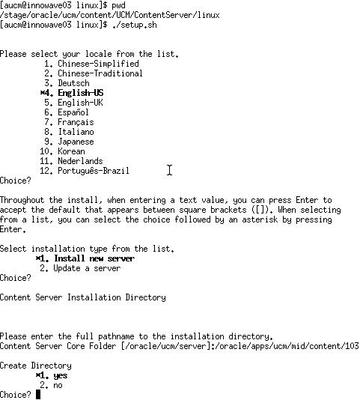
1. Start Installation by running setup.sh from directory as per your operating system.
Provide Locale, Installation Type, Core Folder location.

2. Select JVM, Vault, Web Viewable file repository, Master Server, Admin Server as shown below
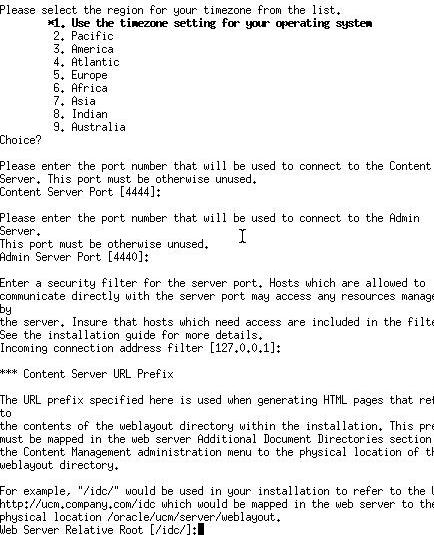
3. Select time zone, content server port, Admin port, security filter, URL Prefix as shown below
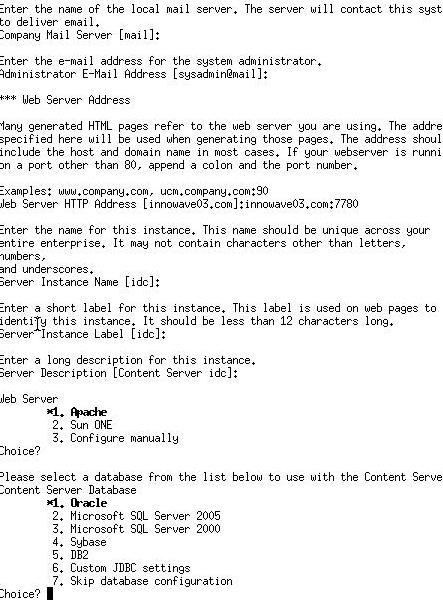
4. Select Web Server Address, Instance Name, Web Server Type and Database Server type
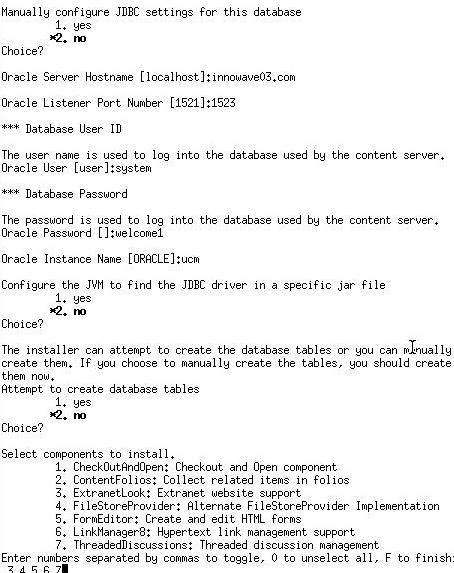
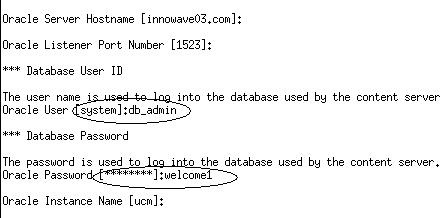
5. Select Database Server, DB Port, DB User, DB Password and Content Server additional components to install
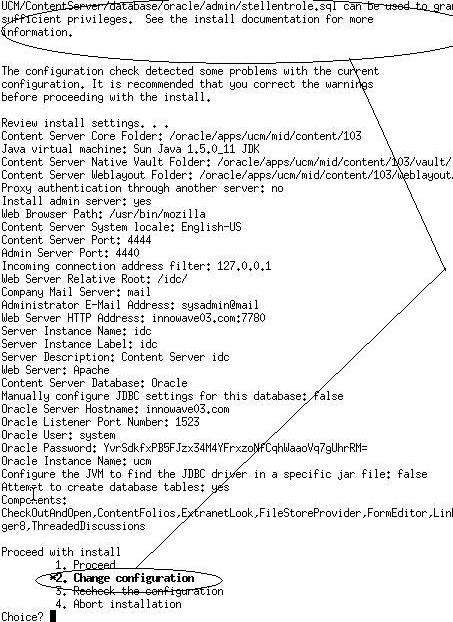
6. If there are no issues you should see option 1 Proceed as highlighted, In my case it was option 2 Change Configuration (means some issue). “stellentrole.sql” missing, on careful inspection I realized I was using wrong database user (system), I should have used db_admin (created above)
7. Rerun configuration and fix issues
8. You should see “1. Proceed” , press enter for installation at this stage
9. Finally output should look like
.
References
How to access Content Server from browser, post install steps , issues during Web Server configuration or Installation of UCM’s Application Modules (Web Content Management, Document Management or Records Management) coming next ….
Related Posts for UCM
- Oracle Universal Content Management Architecture
- Oracle Content Server (UCM) installation overview
- Oracle UCM Content Server Installation on Linux : Step by Step Doc – Part I
- Configure Apache (Oracle HTTP Server) with Stellent Content Server (UCM) – Part II
- Security (Users, Groups, Accounts) in Oracle Content Server (ECM/UCM)
- Start / Stop UCM (Stellent) Content Server idcserver_start idcadmin_start
- Can I install Content Server and Web Server (Apache/OHS) on different machines ?
- Integrate UCM (ECM/Content Server) with Microsoft Active Directory as LDAP Provider
- UCM/ECM 11gR1 software & documentation is now available to download
- Oracle Enterprise Content Management (ECM) 11g Installation Overview : UCM/ IBR/ IPM/ IRM/ URM
- Integrate Oracle ECM/UCM (Content Management) 11g with Oracle Internet Directory (LDAP Server) : Things you must know
- UCM Error accessing /cs “The Server is unavailable” . Could not start up IDC server deployment “csProviderUnableToStartSystem”


Good hands-on exercises (installation, patching, cloning), very experienced trainer worth every penny 
10 users commented in " Oracle UCM Content Server Installation on Linux : Step by Step Doc – Part I "
Follow-up comment rss or Leave a Trackback[...] saw Oracle Content Server (Repository and Core Services for Universal Content Management) installation, We used Apache (Oracle HTTP Server) as Web Server and Oracle as Database. We [...]
Hi Atul,
I am trying to install UCM in my Linux Box, I followed the same procedures in this blog, but i am getting an error in between :
Please enter the full pathname to the installation directory.
Content Server Core Folder [/oracle/ucm/server]:/oracle/apps/ucm/mid/content/103/
Create Directory
*1. yes
2. no
Choice?
Unable to create directory ‘/oracle’.
Content Server Installation Directory
Please enter the full pathname to the installation directory.
Content Server Core Folder [/oracle/ucm/server]:
Create Directory
*1. yes
2. no
Choice?
Unable to create directory ‘/oracle’.
Content Server Installation Directory
I am struck here and donno what to do next to solve this issue. Google is also not helping me
I solved the issue
I am using Oracle Content Server 10gR3
Apart from the standard components and other components, I have InBound refinery Support and Oracle text Search Components enabled.
I get the following error when I check in a pdf or a Microsoft office document.
Text Conversion of the file ‘/.pdf’ failed.*
Content has been indexed with Info only. Resubmit should only be performed if the problem has been resolved.
I am able to perform a full text search on *.txt and *.htm files.
My CS is on CentOS 5.
HI ATUL,
How do I integrate the UCM with EBS 11i.
Hi Atul,
We have integrated UCM 10.1.3.3.3 with OID 10.1.4.2 & OAM 10.1.4.3
Externalization of authentication is working fine and that means user from OID can able to logon on UCM admin console with admin permissions.
The only strange thing we found that sysadmin (the default UCM admin)is still able to access UCM admin console successfully!!
We wish to restrict the access for all UCM native users.
Could you please help me with this?
@ Ashish,
Are you using UCM’s LDAP provider for authentication ?
Are you using setup mentioned in guide here http://download.oracle.com/docs/cd/E10316_01/cs/cs_doc_10/admin/users_security/wwhelp/wwhimpl/js/html/wwhelp.htm ?
Dear Atul,
I am working on Oracle Content Server 10gR3 with OS RHEL4 32bit. We have installed Web Server(httpd), Oracle Content Server and Database 11gR2 on the same machine.
Because in OS 32bit, java processes comsume a lot of memory and not release. So after running a few day, i must reboot machine in order to release memory.
Now, I intend move all (application, database) into OS RHEL4 64bit to solve memory problems. Please show me the way how to do it.
Thanks & Regards
Hi ,
we are using a very old Stellent 7 version thats installed on JDK -1.5 . Currently , they have upgraded the whole firm servers to JDK 1.6 , though Stellent is still on 1.5. COuld you please let me know how we upgrade the stellent box to JDK 1.6 .
thank you
Kanika
@ Kanika,
Raise a call with Oracle Support and ask if 1.6 is supported with JDK1.6 . If it is then upgrade JDK as per JDK upgrade instructions.
I usually install 1.6 JDK in different directory and move 1.5 to backup directory and create a softlink from 1.5 JDK to 1.6 so no change is required in stellent side .
Leave A Reply